KAS aspirants want scaling system like in UPSC
Karnataka Administrative Service (KAS) aspirants are demanding for a scaling system now. Thousands of aspirants will submit a memorandum to the governor on Monday. The scaling system is presently used in Union Public Service Commission (UPSC) where a proportional representation of candidates from each subject will be chosen from prelims to the main. The ratio [...]
Move to get state officers for IAS
The government has proposed special examinations to induct young officers recruited through the State Civil Services into the elite Indian Administrative Service (IAS). Faced with a shortfall of at least 560 IAS officers across India, a proposal for the UPSC to hold “limited” competitive examinations to allow young officers serving in the states to join
UPSC written exam result for Defence Services Exam 2010
The Union Service Public Commission (UPSC) has announced the results of the written part of the Combined Defence Services Examination (I)-2010 held in February 2010. Over 10,239 candidates have qualified for being interviewed by the Service Selection Board of the Ministry of Defence, for admission to (i) Indian Military Academy, Dehradun 130th Course commencing in [...]
UPSC Civil Services Preliminary Examinations 2010 today
The Civil Services preliminary examinations will be held on Sunday at 20 centres in the city. Seven Assistant Examination Coordinators in the rank of Deputy Collector have been nominated by the District Collector, C. Kamaraj, to ensure smooth conduct of the examinations. According to a press release from Mr. Kamaraj, steps had been taken to [...]
Arrangements for UPSC Prelims Exam reviewed
In all 2,906 candidates would be appearing for the Union Public Service Commission (UPSC) (Prelims) Examination to be held on May, 23 in six centres at Tirupati. District Collector V. Seshadri on Wednesday held a meeting with all the concerned officials at the RDO’s office here to review the arrangements for the prestigious examination, like [...]
40% IAS officers from South Indian States
With their children clearing the prestigious All India Service examinations, it has been a dream come true for many IAS officers in the state. The special chief secretary, Mr A.K. Goel, was elated when his son, Mr Karthikeya Goel, was selected for the IAS after securing the 40th rank. Similarly, the excise commissioner, Mr Hiralal [...]
Ludhiana Scientist Gets 16th Rank in UPSC
‘‘When you really want something to happen, the whole universe conspires so that your wish comes true.’’ As these words — immortalized by Paulo Coelho — reverberate in his mind, Prabhjot Singh, 24, knows that his never-say-die spirit and family’s support made it possible for him to secure the sixteenth rank in the coveted UPSC [...]
CAT rejects scrapping of appointment procedure of UPSC
Appointment procedure of UPSC The Central Administrative Tribunal has refused to scrap the appointment procedure by the UPSC for the post of Deputy Director in the Employees State Insurance Corporation (ESIC) on the ground that the advertisement issued by it for the job was vague. Although, the Tribunal accepted the advertisement was vague it said [...]
IAS topper chose rural India over Harvard | Karthik Adapa (Topper, IAS 2008)
Karthik Adapa (Topper, IAS 2008) A doctor by profession, Karthik Adapa gave up scholarships to Harvard and Cambridge to join the Indian Administrative Services. Thinking beyond marks, appreciating the value of each subject and teaching these very subjects to students during his preparation helped him ace the exam.Now stationed at Ranikhet, a small town in Uttarakhand [...]
UPSC announces CISF Competitive Exam, 2009 result
UPSC CISF Result According to an official press release based on written result of the Central Industrial Security Force (CISF) (Asst. Commandants) Limited Departmental Competitive Examination, 2009 held by the Union Public Service Commission (UPSC) in December 2009 and the Personality Test held in March 2010, a total of 20 candidates have been recommended for [...]
Tuesday, July 20, 2010

UPSC Syllabus 2011 for Civil Services, CSAT, IAS, General Studies, Geography
UPSC Syllabus
UPSC holds a very significant role in governing the law of India. It is meant to appoint the candidates for the post of civil services in India. This cannot be possible without a test. This is simply because not every individual can be selected for the job which is really serious and needs intellect. These exams are the medium to check their overall knowledge and only then can they pass through this fire test to reach their mission of acquiring a job in civil services.
IAS, IFS, IPS, CSAT Syllabus 2011
In this life, everyone has to undergo many phases to reach their desired goal. In order to fulfill your goal hard work is needed. One has to be always prepared for the toughest challenge to prove his/her worth. There are many people who apply for the UPSC examinations. But, do they all succeed? Obviously, no, the aspirants those who have envisioned their goal and have burnt the midnight oil lamp reach their pinnacle of success. The UPSC syllabus is very tough and takes whole lot of concentration and capability. It is not an easy thing to crack.
UPSC exams demand excessive zeal and the extensive reading. Every year in-numerous aspirants apply for these exams and if they get through this their job in civil services is confirmed. UPSC is a division of constitution of India which acts as a mediator between a student and the job. One has to meet all the requisites to clear off the path to their mission of acquisition of job.
Subjects
1. GEOGRAPHY
2. PUBLIC ADMINISTRATION
3. SOCIOLOGY
4. HISTORY
5. PSYCHOLOGY
6. POLITICAL SCIENCE
7. TAMIL LITERATURE
8. GENERAL STUDIES
UPSC exam structure
* UPSC syllabus covers all the subjects and mostly political subjects are stressed.
* The scheme of examination is basically divided into two papers, namely: General Studies which bear 150 marks and other consists of the optional subject that has to be chosen from the subjects that are given.
* The second paper carries 300 marks. General studies consist of syllabus on various fields like agriculture, animal husbandry& veterinary civil engineering.
* There is syllabus of science, commerce, geography, etc. Law and history are also subjects that are covered in general studies syllabus.
One has to be prepared fully to clear this 500 marks examination of UPSC. This is not all, even if you have cracked the UPSC exam; there is another hurdle to cross. It is an interview which is conducted to further check your capability and intellect. These interviews deal with random subjects so the aspirant ought to be prepared on every subject. It is the final step to enter the field of civil services.
Everybody has to be equipped with the information and they need to be updated if they are looking forward to give a good performance in UPSC exams. These exams are really tough which require rigorous hard work and diligence. One has to keep up with all the current affairs. There has to be a benchmark to assess the individual’s capability and this can be done through many ways. UPSC exams may seem to be tough but if the person is focused towards his goal then there’s nothing that can stop him from attaining the heights.
© 2009-2010 UPSC.com
Wednesday, May 12, 2010
Saturday, January 30, 2010
UPSC, IAS, Coaching Center Notes, Print & Class-Notes
UPSC, IAS, Coaching Center Notes, Print & Class-Notes
Tuesday, September 22, 2009
10 Most Captivating Deserts
Here are 10 of the most Captivating and Bretahtaking Deserts! From the Sahara, the worlds largest to the Farafra in Egypt and even the Taklamakan, a desert covered with snowfall!

Taklamakan (Central Asia): a desert covered with snowfall

Taklamakan is one of the largest sandy deserts in the world, ranking 15th in size in a ranking of the world's largest non-polar deserts. It covers an area of 270,000 km2 (100,000 sq mi) of the Tarim Basin, 1,000 kilometres (620 mi) long and 400 kilometres (250 mi) wide. It is crossed at its northern and at its southern edges by two branches of the Silk Road as travelers sought to avoid the arid wasteland.
In 2008, China's biggest desert experienced its biggest snowfall and lowest temperature after 11 consecutive days of snow. Snow is rare in the desert that covered 337,600 square kilometers, never before had the whole desert been covered.
Lençóis Maranhenses (Brazil): a ‘desert' with lagoons
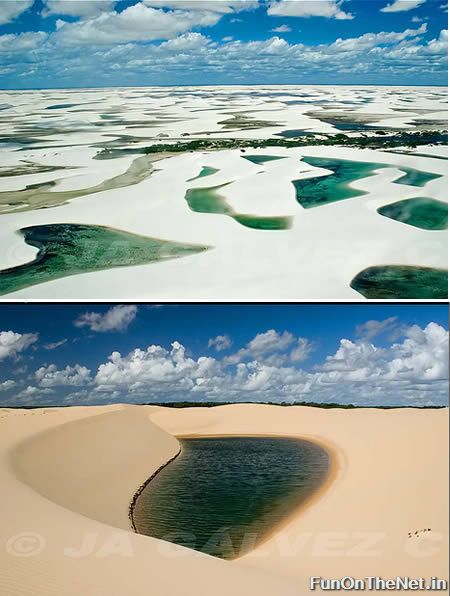
It seems incredible, but in a country that keeps around 30% of the fresh water and shelters the largest rain forest in the world, we can find a “desert”. Located in the State of Maranhão, on the north shore of Brazil, the Lençóis Maranhenses National Park is an area of about 300 square kilometers (155,000 ha) of blinding white dunes and deep blue lagoons, forming one of the most beautiful and unique places in the world. The dunes invade the continent over 50km (31 miles) from the cost, creating a landscape that reminds a white bed sheet, when seen from above.
But you may ask: -Lagoons?? You told me it was a desert… Yes, what defers this region from a desert is the amount of rain that drops over the dunes, creating ponds of crystal clear water on the depression between dunes. Despite its desert-like appearance, Lençóis Maranhenses records an annual rainfall of 1,600mm (i.e. 62.9 inches), 300 times more than in the Sahara. During the period of drought, the lagoons evaporate and become completely dried. After the rainy season, the lagoons are home of many species of fish, turtles and clams. The mystery in this story lies in the fact that when the lagoons fill up, life comes back, as if they had never left the place. One of the hypotheses to explain the phenomenon is that the eggs of the fish and crabs are maintained alive in the sand, exploding when rain comes back.
Salar de Uyuni (Bolivia): the world's largest salt desert
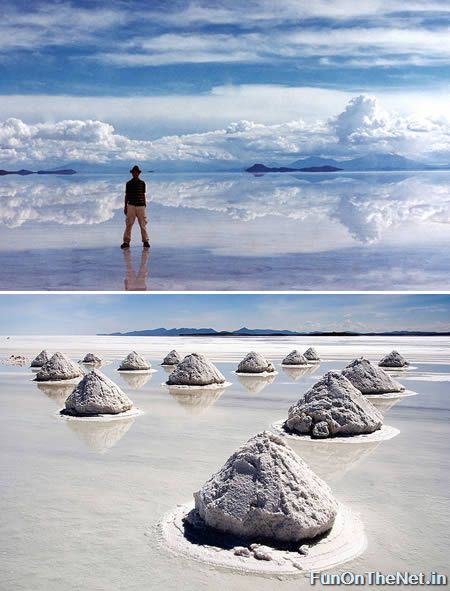
The Salar is one of the iconic images of Bolivia, a massive salt desert in the middle of the Altiplano. It is an expansive, virtually flat desert that reflects the sun in such a way as to create a mirror effect with the sky. There are several lakes in the desert with strange colours from the mineral deposits in the region.
Some 40,000 years ago, the area was part of Lake Minchin, a giant prehistoric lake. When the lake dried, it left behind two modern lakes, Poopó Lake and Uru Uru Lake, and two major salt deserts, Salar de Coipasa and the larger Uyuni. Uyuni is roughly 25 times the size of the Bonneville Salt Flats in the United States. It is estimated to contain 10 billion tons of salt, from which less than 25,000 tons is extracted annually.
Farafra (Egypt): the white desert
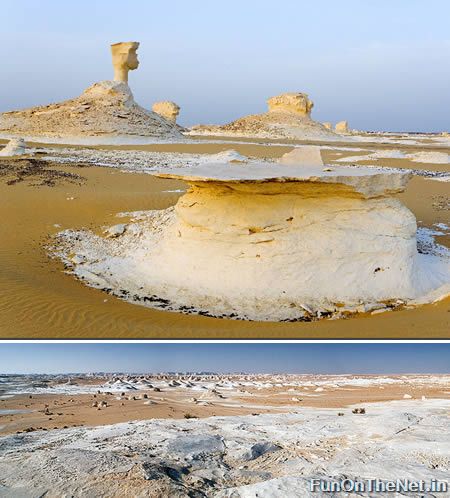
A main geographic attraction of Farafra is its White Desert (known as 'Sahara el Beyda,' with the word 'sahara' meaning a desert). The White Desert of Egypt is located 45 km (30 miles) north of Farafra. The desert has a white, cream color (it is truly white, in clear contrast with the yellow deserts elsewhere) and has massive chalk rock formations that have been created as a result of occasional sandstorms in the area.
Atacama (Chile): the flourished desert
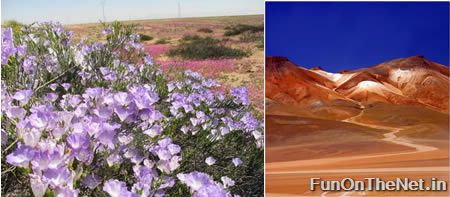
The Atacama Desert occupies the largest amount of the Chilean territory located north of the 29th parallel. The area located on the coast between Arica and Antofagasta appears in the Guinness Book of World Records as the driest place in the world. Nevertheless, to the south of the Tropic of Capricorn, the desert becomes kinder towards living beings. The coastal mists, "camanchacas", are more abundant south of Antofagasta and bring the humidity necessary for the maintenance of the coastal scenic vegetation. Many plants survive mainly because of the "camanchaca", and the harsh savings of water, in normal dry years, that causes them to delay important functions such as growth, to favor survival and reproduction. (Link)
Namib (Namibia): the only desert with elephants
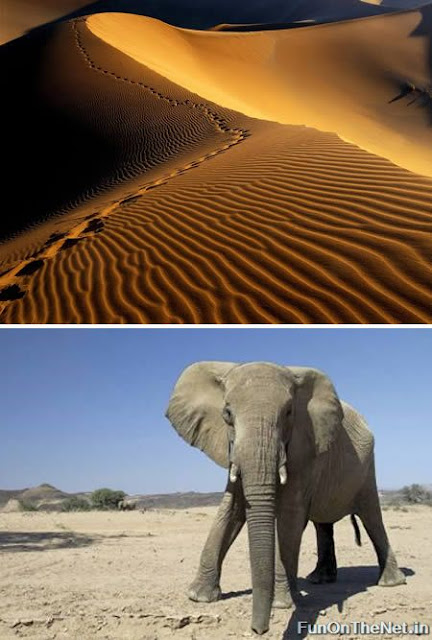
South of Africa lies the Namib desert. which is less vast than the Sahara but just as impressive. It forms part of the Namib-Naukluft National Park with neighbouring Angola. The Sossusvlei sand dunes are the highest in the world, some towering at 300m high and if you are lucky enough, you can stumble across desert elephants-the Namib is the only desert in the world to have elephants. Apparently the oldest desert in the world, myriad species of plants and animals can only be found here. The Namib has fascinated geologists for years but it remains very little understood to this day. Off the coast, strong southerly winds with fogs and strong currents cause sailors to lose their way; the north coast has been named 'Skeleton Coast' due to the amount of shipwrecks found there, some of which can be found as much as 50m inland, as the desert slowly takes over the ocean as it moves westwards.
Simpson Desert (Australia): the red sand desert
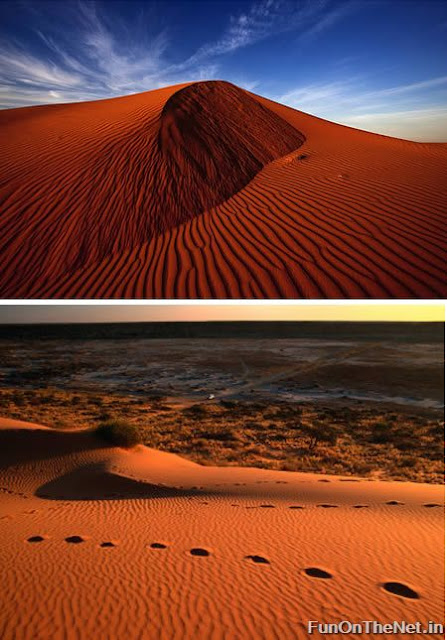
Australia is home to four large deserts, popularized by Mad Max: Sturt's Stoney Desert, Tanami Desert, the Great Victoria Desert and the Simpson Desert, which is also known as 'The Big Red' due to the presence of dunes of red sand. The Simpson Desert is an erg which contains the world's longest parallel sand dunes. These north-south oriented dunes are static, held in position by vegetation. They vary in height from 3 metres in the west to around 30 metres on the eastern side. The most famous dune, Nappanerica, or, more popularly, Big Red (named by Simpson Desert traveller Dennis Bartell), is 40 metres in height.
The Black Desert (Egypt): the desert with black stones
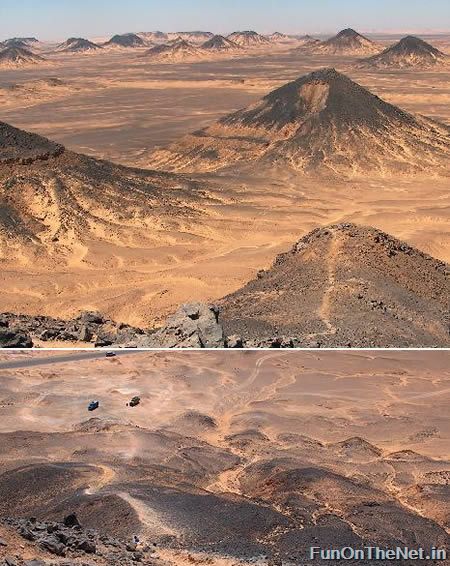
Located 100km northeast of the White desert, the Black Desert is a region of volcano-shaped mountains with large quantities of small black stones. The stones lie out across the orange-brown ground, so that it is not quite as black as many people may hope for. Especially after visiting the White Desert, which has formations that are really white, many will imagine a desert as dramatic as this. Climbing one of the many soft peeks, the view from the top is really nice, with similar peeks continuing on into the haze. The Black Desert is uninhabited. (Link)
Antarctica: world's driest and wettest desert
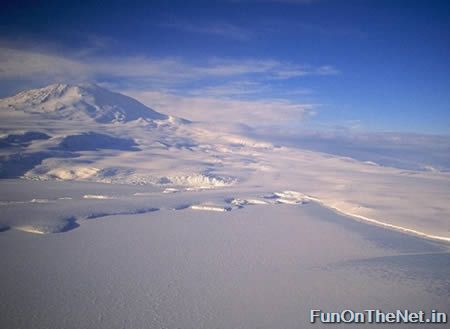
Antarctica is a land of extremes. It's not inhabited year round by humans because it's simply too freezing cold. In 1983 scientists recorded extreme cold temperatures as low as -129 Fahrenheit. It's also the wettest place on Earth, but simultaneously the driest. The reason it's the “wettest” is not because of rainfall; since Antarctica is covered by 98% ice, it's technically very wet. However since it's also the aforementioned coldest place in the world, it gets very little precipitation – less than 2 inches a year. Which makes Antarctica a desert. A brutally cold ice desert with a massive trench full of even more…ice. Three for the price of one!
Sahara (North Africa): world's largest desert
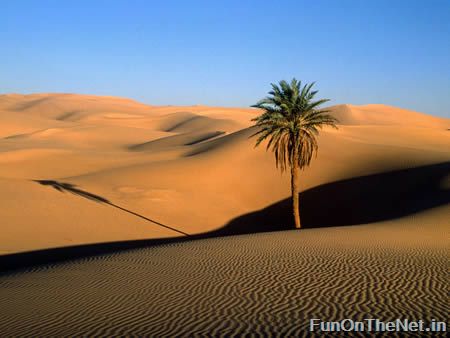
The Sahara, with a size of 8.6 million km², is the world's largest desert, covering large parts of North Africa. Around 4 million people live there. Its maximum length is 4,800 km, running from west to east, and up to 1,200 km from north to south. Sahara covers most of Mauritania, Western Sahara, Algeria, Libya, Egypt, Sudan, Chad, Niger and Mali, and touches Morocco and Tunisia.
Sahara is very dry but there is an annual rainfall in most regions, although just a few dozen millimetres.
Saturday, June 6, 2009
Time Management to Crack IAS Paper
If you want to achieve a job in Indian Administrative Services and want to do something in life, ask yourself have I achieved success, am I there yet? If no, then what are the things that could lead me to success? These are greatest thoughts to ponder, and I bet all those who succeed in life in some way or the other must have asked these questions to themselves at some point of time. Students often complain that they do not know where the time goes. Whether one is an executive, a student or a homemaker, everyone wants to achieve more in even a minute of the day. The key to success is Time Management and therefore it becomes important to squeeze out the most out of even a second.
Many youngsters around all of us can be seen spending their time in frenzy of activities like watching movies, playing games, gossiping, roaming around etc. Over here, we are not going to blame all of them, but yes, we are going to discus why these youngsters are not able to achieve more from their life. It is because they do not concentrate on the right things. With the over-accelerating competition in the arena of education, students need to understand that they are perpetually busy but it does not necessarily mean that they make optimum utilization of their time. And therefore students today are in great requirement of managing their time effectively.
You must have heard the child in your neighborhood saying he is busy; it is important to note here that 'Busy' stands for two kinds of people- those who are chaotically disorganized busy and calm effective busy. It is to be understood that the latter ones lend up themselves in something more productive as far as work is concerned. Enhancing the effectiveness is something that calls for some standard Time Management skills.
In order to manage your day, it is better to have a personal sense of time log; this will help you track how you spend the day. Divide each day for a period of two weeks into one hour intervals and write down what are you going to do in the two slots. Under them you can divide the activities and examine your time log. You may come to know that very little time goes into top priority works and more time is wasted in coffee breaks, chatting and receiving phone calls. Try to deduce the time spent on these ineffective activities or stop doing them altogether. After cutting down on these things you will find that your efficiency level is increasing and obviously the end results will be on your side. Also, just take a look at the following points, as these can prove to be helpful while u prepare:
• While preparing for a set of subjects in IAS syllabus, ensure that you would be appearing for a multiple choice question papers, where subjects such as History, maths and geography may prove to be highly scoring. Choose subjects whose preparation material like IAS Exam Material books, IAS Comprehension Test, reading material and guidance books are easily available in the market.
• Your General Knowledge will definitely pay in your IAS prelims examination which can be improved through keeping a tab on day to day happenings by reading newspaper, watching television news, etc.
• For all those who are lucky enough to clear IAS mains and reach interview stage, then bookish knowledge itself won't do. Mind alertness counts when somebody asks tricky questions on "how many steps you walked to reach the office?"
• Improving the personality is quite important as this will definitely be one of the criteria for selection. Physical and mental wellbeing is quite important for IPS.
• Try to enhance your communication skills as the civil servants must be proficient in at least one foreign language.
Tips for Choosing an Optional
A meticulously sought after planning and proper & timely guidance can enable an alert individual to clear the tough UPSC examinations. According to the UPSC aspirants, half of the battle is won right after selecting the right optionals for the Union Public Service Commission (UPSC) selection examination. Provided that optionals in each IAS preliminary and IAS mains examination determine a candidate's scoring pattern, questions asked in the final interview are based on the choice of optional subjects chosen. This makes the decision extremely difficult as well as critical.
There is a plethora of subjects to choose from, since students belong to varied streams of education, the subjects on offer include Science subjects that expands over Physics, Chemistry, Botany and Zoology; Humanities subjects that expands over History, Political Science, Public Administration, Geography and Sociology and languages such as Hindi, English, Urdu and Pali. UPSC also offers subjects such as Anthropology, Psychology and Philosophy. Additionally, the more number of subjects make it more difficult for students to make choices in optionals.
Optional subjects are chosen on the basis of a number of parameters, on one hand there are optionals that are considered to be scoring where as there are others that are favored for their relevance to either General Studies papers or Current Affairs and essay questions whereas there are many who choose subjects for their defined set of topics asked and comparatively short type answers. Students feel that this bit of planning makes their choice of subject a success as there are combinations that have common IAS syllabus which reduces their workloads and improves their chances of scoring in civil services examination.
Likewise botany and zoology are two complementary optionals that have common syllabus as these prove to be advantageous for their future. The IAS syllabus talks about emerging issues such as genetically modified (GM) foods, cloning, biotechnology and environmental sensitization. However, students should also show their aptitude skills for the subject they choose as they require a fair degree of specialized knowledge. While preparing for the optional, it is advised to study first for the IAS mains paper and then prepare for IAS preliminary as this provides students an edge and then allow them to specialize in certain scoring areas.
How to Crack IAS Paper
Appearing for IAS and IPS through combined Competitive Examination for Civil Services Exam and recruitment into Indian Forest Service is not so easy. UPSC is a self prevailing government organization that ascertains that the recruitments are conducted on the basis of impartial examination pattern and therefore the notification for the examination is published in the employment news or daily newspapers so that each and everyone knows about its happenings.
The competitive Examination is conducted as per the following three steps:
Step I- Preliminary Examination
IAS prelims is written objective type examination and is conducted in the month of June every year with two following papers:
Paper I- General Studies paper with maximum mark 150 against 150 questions. The exam expands over two hours and questions are asked from six topics which are Indian History, Constitution of India, Geography, Economics, Science and Current Affairs.
Paper II- The second paper is an optional of student's choice which may include Political Science, Psychology, Economics, Physics, and Economics etc. This exam has maximum marks 300 against 120 questions and is two hour long.
IAS prelims are very competitive and therefore only highest scorers qualify for the second stage that is the Main Examination. It is quite interesting to note that the qualifying percentage is 10% in preliminary examination.
Step II- Main Examination
IAS Mains is a written examination which is a subjective or essay type format. This is generally conducted in the month of November/December. IAS Mains expands over nine papers:
Paper I & II- Language papers with maximum marks 300 each. One paper is English which is mandatory and the other is any Indian language mentioned in the eighth schedule of Indian Constitution. Passing these papers with a certain minimum percentage is necessary.
Paper III- This is a subjective type paper with maximum marks 200. Student can opt to write in either English or any other Indian language mentioned in the eighth schedule of the Constitution.
Paper IV and V- General Studies with General Knowledge and Current Affairs and maximum marks of 300
Paper VI, VII, VIII and IX- Two optional subjects, with two papers thereby making it four papers with 300 each and total marks of 1200.
Those who pass IAS mains are further reduced with a ratio of 1:10 to direct students to the next level that is Personality Test.
Step III- Personality Test
This is the final elimination stage and as expected the competition is highest at this stage. Candidates are selected with a ratio of 1:2 and therefore with 10 vacancies, twenty candidates are called for interview. These candidates are tested on their personality, social traits, teamwork and leadership qualities and their aptitude and skills that are usually involved in work.
After the personality test, the candidates have to also undergo a mandatory training at Lal Bahadur Shastri National Academy of Administration in Mussorie as a probationary officer. This is the foundation course, after which specific job-oriented training is conducted separately by each service.
How To Study For IAS And Preparing Notes
Preparing for civil services exam can prove to be a tough and unachievable task for all aspirants, but it is just the same as preparing for any other qualifying entrance which is held across the country today. For preparation, it is important to know the IAS syllabus of the optional subjects that you have opted; also you must have arranged the books for the same and must surely have made notes that may help u in long run to revise the IAS syllabus.
The notes you prepare must be written clearly as well as in a perfect order, so that you can refer to them in future. There are varied methods to prepare notes that include Linear Notes, Voice Notes and Pattern Notes.
Linear Notes- Talking of preparing linear notes, in this method, the study material is condensed in the form of headings and sub headings under which the most important points are jotted down. These kinds of notes can prove to be really helpful and making them is quite easy as while preparing linear notes from book, the material is already arranged properly in the book. However, there is one disadvantage of this method that while making notes, the students end up in copying the bookish language that proves to be fatal sometimes and defeats the purpose of condensing the matter at a single place.
The correct way to make use of this way is by using loose sheets in place of exercise book as it is easier to keep adding information. Leaving space in between of notes may help to integrate your notes with additional information in future. In order to make these notes look attractive you can utilize different colors, Fonts, capital letters, boxes and highlighting whenever necessary. This can draw your attention at certain content while preparing.
Pattern Notes- These kinds of notes are made as a pattern with the beginning of the topic written at the centre of the page. Just like the rays of sun, each line radiating out of the main idea is written in a brief way with the use of phrase or a keyword. This method can prove to be better than the linear approach as one can add more information without any hurdle of space. Also, the entire pattern can be seen at one go, without turning pages. Additionally, you can indicate links between different topics easily than the linear notes method.
One more plus-point of pattern notes is that it makes outstanding utilization of memory for revision as the aspirants keep jotting down points as they appear. And this makes it easier to remember as only phrases are used for making notes.
Voice Notes- Finally, talking of voice notes, this is a new method of preparing notes, as it requires a computer and internet connection. There are websites that offer clippings of classroom preparation for Indian Administrative Service, this way; you will be using your sensory organs which will help u remember this for a long time.
Sunday, March 29, 2009
Uttar Pradesh Public Service Commission

About Us Advertisements Notices & Tenders Results Rejected List Syllabus
Key Sheet Information Regarding Public Information Officer and Appellate Officer

Thursday, March 19, 2009
Subscribe to:
Posts (Atom)